Amber Das
I am lucky that I was born into a very musical family from my mother’s side. My mother, Lt Sailabala Das, was a talented songwriter, singer, and composer. She even penned a few songs for the legendary Bhupen Hazarika. Additionally, my late brother Bhaskar Das was a well-respected singer and multi-instrumentalist. It seems that musicality runs in the family genes. I began my musical journey by playing percussion instruments around the age of 7 or 8. Over time, I progressed to drums, guitar, and various other instruments. While I didn't receive formal training, being constantly surrounded by exceptional musicians allowed me to learn quickly and absorb their expertise. My brother and cousins were a continual source of inspiration, as they formed one of the earliest rock bands in Assam.
Later, I had the privilege of crossing paths with Mr. Jurgen Busse, a highly regarded jazz drummer and music educator from Hamburg, Germany. His guidance pointed me in the right direction and greatly influenced my musical development. Additionally, I honed my guitar skills and learned the intricacies of music arrangement from the late Rana Roy, a towering figure in the musical landscape of Assam.
What would you be doing right now, if it wasn’t for your music career?
No matter the profession I found myself in, my heart would always beat to the rhythm of music. Otherwise, I might have stayed in my previous role as a Lecturer in English Literature. Surprisingly, not many people are aware that I spent approximately 7 years teaching in a college. During that time, music was more of a pastime than a profession. However, the pull of my musical calling grew too strong to ignore.
Moreover, one of my cousins, the late Jogen Baruah, planned to open a state-of-the-art recording studio in Guwahati called The Sound Zone, and wanted me to be a part of it, that was the trigger I was probably looking for, and I left my job and the apparent security that it provided and here I am.
Is there a specific project that stands out to you as particularly memorable or significant? If so, could you briefly describe it and explain why it was special?
Many of my projects hold a special place in my heart, making it a bit challenging to pick just one. Among the ventures I undertook in Assam, the Assamese album "Porisoy Bihin" stands out prominently. It marked the beginning of my journey as a music producer.
Another significant milestone in my musical career was collaborating with my partner Sanjoy Dazz on the BGM score for the movie "Sunglass," directed by the legendary Rituparno Ghose. Although it turned out to be his final film, it, unfortunately, never got released.
Additionally, working on the music for "Incredible India – Jammu & Kashmir" alongside Sanjoy Dazz was a truly enjoyable experience. We had the opportunity to explore Kashmir and Leh, even venturing into some restricted areas. We connected with numerous local artists and had memorable jam sessions. As anticipated, both the films and the music turned out exceptionally well. It marked a noteworthy milestone as it was the first major TV commercial I worked on.
Presently, I'm occupied in our Assamese feature film "Jiya," by my wife Sarmistha Chakravorty and directed by Kenny Basumatary. It is extra special because we are the producers as well.
How do you see your journey so far?
My journey is like that of any other, with its fair share of ups and downs. The only difference is that, in the case of artists those slopes become steeper. Moreover, the journey never stops until you do. Unlike a lot of other professions, creativity doesn’t come with an expiry date. Also, I don’t have a fixed destination to rush to and the goals always keep changing.
Life itself is the journey and music is a major part of mine, I’d say I’ve been luckier in my music career than a lot of much more talented and dedicated people. I have a sweet son and a loving wife, so far so good.
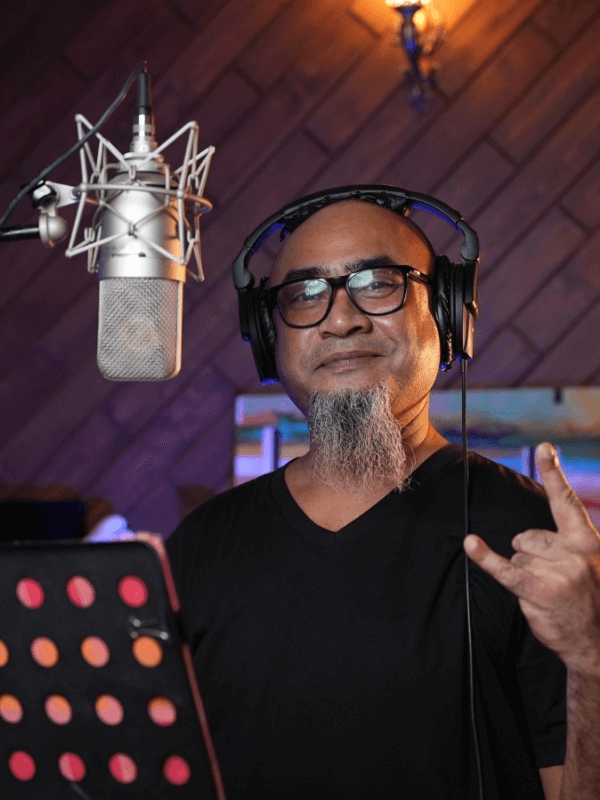
What defines your music style? How do you approach each kind of music?
I don’t really believe in genres anymore, there are far too many. I come from a very Rock background, so the element of Rock and Blues will always be there. Over the years I have done almost all kinds of music, Metal, Blues, Rock, RnB, Bhajans, Ghazals, Folk, EDM, Bollywood, and everything in between.
The approach depends on the kind of music. When doing music professionally, we should keep in mind that it’s a job that needs to be done professionally to the best of our abilities. As for musical approaches, when I’m doing a jingle it’s a different mindset. You have to do a master which is probably a 30 to 60-seconder, but also have edits that are shorter. And you have to do it all in a day, in the presence of clients, agency and production people and of course the director. It’s fun and challenging in the beginning. While movies are quite different. You have more time, and it also more work. Sometimes you end up making so many different versions of the same song until you hit the target. Especially with a director who’s unsure. BGMs are more in the neutral zone. Daily soaps are a whole different ball game.
My favourite is my own music where I’m the boss and can do whatever I please and there are no specific deadlines.
How do you navigate working with other musicians, directors, or clients to achieve a common artistic vision? Can you share any specific challenges you have faced in collaborative projects and how you overcame them?
Music is mostly a collaborative process and even more so when you do it professionally. As I mentioned, professional artists are like service providers and it’s more about coming up with a successful product rather than immersing yourself into creativity and madness. That is something you do with your own music.
It's paramount to get on the same page with the clients and directors and help them enhance their vision sonically. I have done ad films where I just play a couple of notes, and the whole story is driven by visuals and sound design, and it’s perfect.
It’s always easier to work with people who know precisely what they want or people who are clueless and will listen to what I say. The in-betweens are the problem. They have some vision of their own but they can’t explain it properly. They often try to describe something and what you understand is totally different. Sometimes you get them, but sometimes you don’t.
It's difficult to pick out a specific challenge out of so many. I can say I’ve produced music for music composers who didn’t know what a chord or a scale is. They have no idea about musical instruments and their use, and yet they are under the delusion that they know music. That’s quite challenging.
Can you highlight some of your significant achievements and milestones?
While I can't claim to have accomplished a great deal yet, there have been instances in my life that stand out. Ironically, I can't recall my very first significant achievement with absolute clarity; my mother often reminded me of it. At around the age of 5, I had the privilege of singing alongside Dr. Bhupen Hazarika, and it marked my debut in composition. It might have been a somewhat whimsical endeavour, but I distinctly remember the thunderous applause that followed, and the legendary Dr Hazarika himself cradled me in his arms. I didn’t realise it then but that moment was significant.
Later, during my teenage years, I was the drummer for a rock band, and a notable incident occurred when my brother Bhaskar Das attended one of my performances. Coincidentally, he arrived just as I was in the midst of my drum solo. Upon returning home, I later learned that he was moved to tears in front of our mother. My brother was at that time gave the appearance of stern individual and was a highly demanding musician, which meant I had to put in additional effort to earn his approval. To this day, it remains one of the most significant moments in my life.
There are too many milestones as such to recount, and I embarrassingly admit that I don’t exactly remember a lot of my professional milestones.
Touring with the band Soulmate was a great experience. I learnt a lot about the blues from the great Rudy Wallang. Playing in Independence Rock Mumbai as a drummer for the band Faith was another noteworthy moment. Furthermore, composing music for the web series "The Final Call" featuring Arjun Rampal, and creating the background music for "Rangbaaz," another web series for Zee5, were both memorable projects.
The release of the music for the film "Jagjivan Ki Patni Ka Teesra Pyar," starring the late Vikram Gokhle and Revathy Asha, along with contributing songs to another film called "Five Point Three," was incredibly gratifying. It's heartwarming to know that people loved the music.
Who is your musical icon and influence?
There are just too many. One of my all-time favourites is Bobby McFerrin. The Beatles, Deep Purple, Led Zepp, Iron Maiden, Frank Zappa, Yanni, Mark Knopfler, Eagles, Bob Dylan, Sting, Pink Floyd, Queen, Jayanta Hazarika, Rd Burman, Ilaiyaraaja, Handel, Hans Zimmer, Steven Wilson, Dave Weckl, Toto, Rush, Zakir Hussain, Trilok Gurtu, Nitin Sawhney, Jai Uttal, AR Rehman, Salim Sulaiman, Papon, Joi Barua, Zubeen Garg…the list is endless.
How do you inspire yourself while composing?
The process differs according to different requirements. In making my own songs, I mostly go with the flow initially, then come back to it later. I am very critical of my own work so I take a lot of time, until someone literally forces me to release it. Mostly the people involved or otherwise my wife. My first Hindi song “Suna Hai” happened because of the lyricist and my dear friend Pinky Poonawala. Similarly Pritisha Borthakur is responsible for “Hazy Days”.
But when working for very corporate clients I am very fast, and it’s often more about understanding the requirements of the project and giving the best for the project. I learnt the hard way that my best might not always be suitable for the project. I have composed some songs for the biggest brands, sung by the most renowned singers in the country, one of those compositions was done in about 20 minutes and was instantly approved. And later got a lot of appreciation,
What do you do when you are not performing?
These days mostly nothing. I would watch something, surf the Internet, or play around with new music or software. And even when we are not engaged in some project there’s always something to do or something new to learn. I like to keep myself updated with all the fascinating things that’s been happening around.
AI has taken a sudden huge leap, and it’s still in a nascent stage, the future of music too, will be very different. Simultaneously we are looking to the past and everything seems to be making a comeback albeit with new packaging. The world is getting smaller every day, but individually we are more isolated than ever.
Your recent work “Hazy Days” is winning hearts across the country. Tell us more about it.
As I mentioned earlier, this song happened because of the lyricist and dear friend Pritisha Borthakur. She came up with the lyrics which resonated with me and the song just flowed spontaneously. There were very minor changes in the lyrics from the initial draft. We just added the bridge portion later since we felt the song needed that.
I really need to thank the people who made this song what it is. Dishankan Baruah for the lovely guitars, Abhinav Borah for the groovy bass, Aslam Khan and Benvin Fernandes of Headroom Studios, and visual artist Anuradha Duarah. I can’t thank them enough for their wholehearted contribution.
Can you share any upcoming projects or ventures that you are currently working on or planning for the future?
As always, there are quite a few projects in the pipeline. Apart from my usual jingles, there are a few other commercial projects I can’t name yet. But I can promise some interesting music. Besides our Assamese movie “Jiya” has some lovely songs sung by the likes of Papon, Shankuraj Konwar, Maitrayee Patar, and of course Sarmistha.
I am also planning to release a few of my songs which are near completion. One is an anti casteism song title “Ekolobyo” it about the prejudice and discrimination, brilliantly written by Rahul Gautam Sarma. I’m also going to complete and release some of my other songs such as; “Tabla Blues”, “Beggar on a Beach of Gold” (a somewhat philosophical progressive rock), “Dinobondhu Baruah” (written by Chandana Pathak, it’s about old people abandoned by their children), “The Flood Song” (about the recurrent floods of Assam), and there are many others in the pipeline. I am also checking out a few new lyrics Pritisha sent me, some of them look very promising. My job is to create, and that will go on as long as possible.